The Key to Understanding Economic History -- The Entrepreneurial Spirit of China (1860–2020)
Updated: Sep 30
(Editor's Note: In 2020, the China Entrepreneurship Museum was established. The philosophical core of this museum, and its academic challenge, lies in how to distill and summarize the essence of Chinese entrepreneurial spirit from 1860 to 2020. What were the generational characteristics? Who were the representative figures? What constituted their personalized entrepreneurial spirit?
The research team brought together economists, historians, and management scholars. The project was ultimately completed in the form of commentaries on more than 100 entrepreneurs, who are now permanently on display in the museum. Fu Xiaoyong led the research team, and this essay is the preface he wrote for that report.
This year marks the 250th anniversary of the founding of the United States. The Rocky Mountain Entrepreneurship Global Research Center holds a greater curiosity to explore the entrepreneurial spirit of the United States and promote it on a wider scale.)
1.
Economic history is the history of the metabolism of products, services, technologies, and industries. The most important role of entrepreneurship is to drive the emergence of new products, new services, new technologies, and new industries. Understanding entrepreneurship is therefore the key to understanding economic history.
The word "entrepreneur" traces back to the Spanish root empresa, meaning "to discover, to see, to perceive, to know, to capture." In its original sense, an entrepreneur was someone who resolutely carried out an arduous and difficult task. In the Middle Ages, such tasks typically meant waging war or building a cathedral. What made these people capable of completing them was "entrepreneurship," a distinctive form of self-drive, or "a persistent hunger to find, discover, create, or determine new goals and new means." By convention, the terms entrepreneur, entrepreneurial talent, and entrepreneurship are used more or less interchangeably.
Adam Smith explained very early on why economies grow. An expanding market deepens the division of labor. A deepening division of labor drives technological progress, which in turn drives economic development. Economic development raises incomes, and rising incomes expand the market further, so that the cycle begins again. Schumpeter correctly pointed out that all four links in this chain are driven by entrepreneurship. He was not the first to propose the concept of entrepreneurship, but he was the one who identified its essence with real depth: innovation.

Sheng Xuanhuai (1844 - 1916): Father of State Enterprise
A leading figure of the Self-Strengthening Movement, involved in founding nearly every major state-run enterprise of the late Qing, and known as "the father of Chinese state Enterprise." Sheng Xuanhuai worked with an official seal in one hand and an abacus in the other. He accomplished the impossible through extraordinary means, yet he could never fully escape the logic of the official-merchant. It was precisely his forceful experiments that drove a wave of industrial construction in an otherwise listless late Qing. Yet that same forceful, official-merchant style also cast the Self-Strengthening Movement under a heavy shadow of state monopoly.
—— Excerpted from 《Chinese Entrepreneurship (1860–2020)》
2.
China was among the earliest nations to show commercial acumen, yet it lingered for a very long time within an agrarian civilization. Not until 1840 did the cannon fire of industrial civilization knock at its door. The Opium War was the result of China's backwardness rather than its beginning. As the eminent China scholar John King Fairbank observed, if it had not been opium, it would have been cotton or molasses.
National salvation became the central theme of modern Chinese history. The first task was to "learn to make things," that is, to imitate foreign technology, in what history remembers as the Self-Strengthening Movement. Who would build, and how? At that moment, entrepreneurship stepped onto the stage of modern Chinese history.
The commercial and industrial themes of the Self-Strengthening Movement, and of the late Qing more broadly, have resurfaced again and again in the Chinese history that followed, right down to the present. One was the contest between "official supervision with merchant management" and enterprises run by the gentry or by private hands. Another was heavy industrialization under statism, set against light industrialization along liberal lines. A third was the role of foreign capital and of the comprador class. A fourth was the relative weight of the upstream resource industries and the downstream industries that serve everyday life.
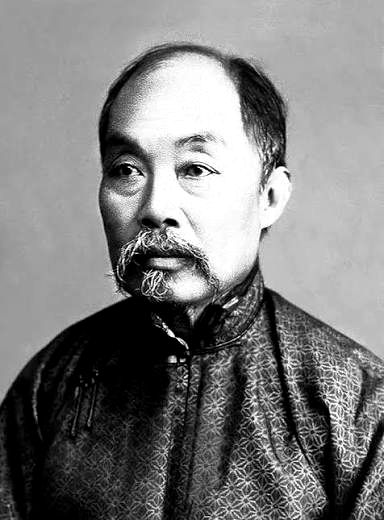
Zhang Jian (1853 - 1926): Leader of Private Enterprise
He placed first in the imperial examinations at 41, and a year later abandoned his official post for business, convinced that industry could save the nation. He founded the largest private enterprise group of the late Qing. Unlike Sheng Xuanhuai's model of "official supervision, merchant management," Zhang Jian ran his factories with full authority as a member of the gentry. This model of "gentry supervision, merchant management" marked a significant advance for late Qing enterprise. The gentry-merchant class he represented rose quickly to become a major force shaping the course of China's transformation.
—— Excerpted from 《Chinese Entrepreneurship (1860–2020)》
Over the 160 years since 1860, China has lived through three golden ages of entrepreneurship: the Self-Strengthening Movement, the early Republican era, and Reform and Opening. It has also lived through two waves of heavy industrialization, first under the Self-Strengthening Movement and later under the planned economy, and two waves of light industrialization, in the early Republican period and again in the 1980s. These were followed by a "third wave" defined by information technology. A "fourth wave," defined by artificial intelligence, is now poised to arrive.
Entrepreneurship is a scarce resource in any society. Over these 160 years, five factors have mattered most in shaping how China allocated it: foreign threats, institutions, ideology, technology, and social attitudes. Different periods produced entrepreneurship of different character, and each era forged an entrepreneurial spirit of its own.
The same 160-year history also demonstrates that the process of creating business value is inherently a process of creating institutional and conceptual value. Entrepreneurship carries meaning beyond the purely economic.

Chen Guangfu (1881 - 1976): China's First Modern Banker
Founder of the Shanghai Commercial & Savings Bank and known as "China's Morgan." A graduate of the University of Pennsylvania. Chen Guangfu introduced Western banking management systems into China, making the Shanghai Commercial & Savings Bank the first Chinese bank to operate in step with international financial norms. Optimistic about the prospects of China's national industry, he lent actively to private enterprises. Riding the wave of industrialization, his bank grew rapidly into the largest private bank of the Republican era, and the only one able to hold its own against state-run financial institutions. Chen Guangfu was the most influential private Chinese banker of the first half of the twentieth century.
—— Excerpted from 《Chinese Entrepreneurship (1860–2020)》
3.
Every list of notable figures carries a particular vantage point, and with it a particular bias. There will always be more remarkable examples of entrepreneurship left off such a list, and there will always be qualities in the figures who do appear that deserve more attention than they receive. This list is not a final verdict etched in stone. It is an introduction meant to invite further inquiry. It strives for accuracy, and it hopes to encourage a way of understanding economic growth, social progress, and modern civilization through the lens of entrepreneurship.

(The article's cover image features the exterior architecture of the China Entrepreneurship Museum. The Museum stands in Heilongjiang, China's northernmost province. The building takes the shape of a tent beneath snow-covered mountains, glowing with warm light on nights of ice and snow, symbolized by the entrepreneurial spirit captured in the Chinese saying "when everyone gathers firewood, the flames burn high." Image courtesy of the ArchDaily.)



Comments