A Boom Without Jobs
Updated: Sep 30
1.
"Delivery 2801, 2804, 2805, scan for number 458, ready!" The girl behind the milk-tea counter called it out, and a yellow Meituan rider shouldered aside the "colleagues" propped against the pickup counter, lifted the milk tea over their heads with one hand and swiped his phone with the other to check the address on his next order.
Another rider pressed her: "2803, faster, it's about to run past the deadline."
"Almost, one more cup." Watching the screen above her, the girl went on chipping ice into the cup. Having scanned the code only when I reached the door, I had by then been standing on the outer ring of the crowd for a good fifteen minutes.
Chinese consumption does not look weak at all. Just back from abroad, I found it hard to square the scene in front of me with the reports of an economy in decline.
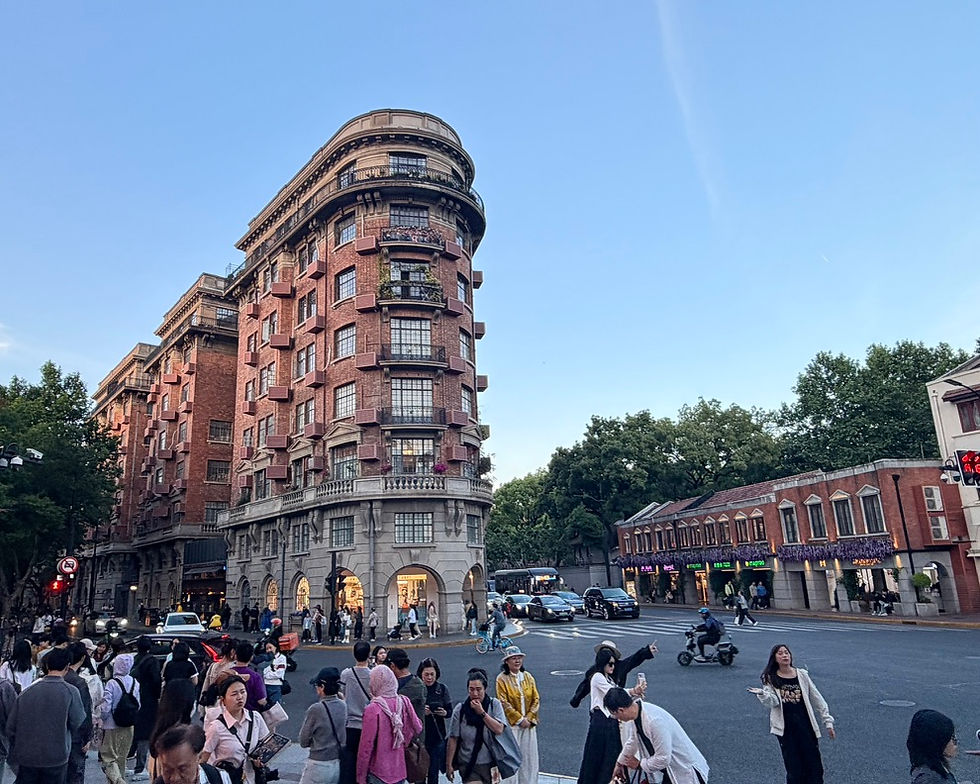
Through this May I worked my way across seven or eight cities, and the impression only deepened. It was not merely that the milk-tea shops were busier. Sanlitun in Beijing looked more upmarket than I remembered it, and the brands in the malls of Hangzhou and Qingdao gave away nothing to those of the first-tier cities. Shanghai pushed the surprise to its limit. Around South Shaanxi Road and Wukang Road, foreigners of every complexion were everywhere. One evening I counted the room in a small bar and foreign faces made up close to half of it, enough to make a visitor forget that the city had ever been shut down in 2022. The entertainment market sent the same signal. A friend wanted to take me to a stand-up show, only to find that three of the moment's most popular comedians were headlining that night and all three had been sold out far earlier.
Yet this filter of prosperity lifts the moment I sit down with local friends, and the conclusion runs the other way.
Both small-business owners and the employees grinding away inside the big firms alike pour out their complaints, and every one of them describes the real state of the economy as “very terrible”.
Business owners complain that operating a company has become increasingly difficult, while employees feel completely drained by the end of each day without receiving any increase in pay. Even individuals facing no immediate danger of job cuts or wage reductions have quietly begun watching their expenses, turning to homegrown alternatives they previously would have ignored as the more practical choice.
Individual cases carry their own bias. Office-leasing data may capture the whole more faithfully. By the end of 2025, Grade A office vacancy in Shanghai, Guangzhou and Shenzhen had climbed to 23.4 percent, 20.65 percent and 29.41 percent respectively. Office leases usually run three to five years, so what they register is what business owners genuinely expect the scale of their operations to be. That expectation matches what my friends describe: thin corporate profits, and a dispiriting experience of work.
2.
Princeton economist Alan Blinder, in A Monetary and Fiscal History of the United States, 1961–2021, examines how American companies turned to a strategy of "wringing the towel dry" to shield themselves during the 2001 Dot-com Bust and the 2008 Subprime Crisis. The process started with defensive, widespread layoffs: nervous about softening demand, employers initially eliminated full-time positions — targeting non-core support roles in particular — and filled the void with temporary or contract workers. An intense squeeze on the remaining staff followed. Anxious about their own job security, surviving workers absorbed the workloads of multiple colleagues.
Consequently, even as the U.S. economy began showing signs of stabilization by mid-2009, employment remained depressed, with unemployment peaking at 10 percent. Corporate performance rebounded through a productivity boost powered primarily by job cuts and workplace fear, yet the broader job market saw no genuine relief — a phenomenon economists term "a jobless recovery."
What China has spent the past two years calling involution, neijuan, is at bottom the same towel-wringing strategy, applied when demand falls short. The employees who keep their jobs are filling the gaps left by the layoffs with extraordinarily long hours. Figures from the National Bureau of Statistics put the average working week for employees of Chinese firms at a high of 49 hours in 2023 and again in 2024. It eased slightly in 2025, to 48.6 hours. Friends of mine, most of them at private firms in the first- and second-tier cities of the east, reckon the real figure runs higher than the published one.
When people are putting in ten-hour workdays — often surrendering their weekends as well — yet remain haunted by the constant threat of layoffs, how can they feel anything but deep insecurity? And as this relentless pressure continues to squeeze workers out, where have those displaced actually gone?
3.
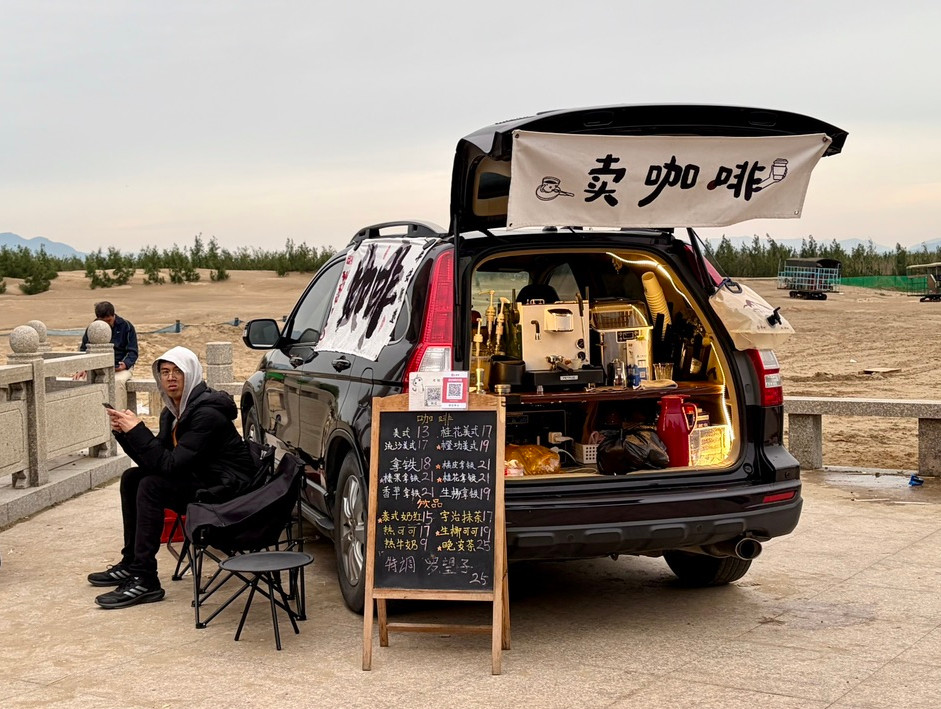
Flexible work is the main outlet that absorbs them, through two channels. One is the "new-form workers": the food-delivery riders, parcel couriers, ride-hailing drivers and e-commerce livestreamers. The other is the traditional casual labor force of domestic workers, street vendors and movers.
A report on blue-collar employment from the China Institute for New Employment Forms at Capital University of Economics and Business finds that food delivery has been the fastest-growing channel of flexible employment over the past two years, with rider numbers rising about 6 percent annually, and that riders under age 35 account for more than 60 percent of the total. Among ride-hailing drivers, whose average age is 39.8, 77 percent joined after losing a job in their middle age.
We once treated the rise of the delivery and ride-hailing platforms as the model case of internet innovation. It now looks more like a stopgap floor under the labor market. Stopgap, because once innovation on the delivery platforms turned into a subsidy war, as competition in the early ride-hailing market had before it, the paradox at the heart of this attractive-looking business came into view.
Someone would object that the platforms freed small shops from geography: the owner needs neither a large storefront nor a large staff, the customer need not come in at all, and the rider earns a living. On the surface, this appears to be a win-win scenario for all parties involved.
Subsidies, though, are bounded in time and space. Even if a subsidy takes the price of an item to zero, and even if a customer orders ten deliveries a day, all that happens is that money from the future is spent in the present. Merchants report that the true all-in rate they pay often runs to two or three times the platform's claimed commission. The customer appears to get goods for nothing and the merchant does get more orders, yet the profit never arrives as expected. Ironically, the busier the shop, the thinner its margin.

Ask yourself, then, why the owner of a profitless shop would keep it open, keep paying wages, keep maintaining or replacing equipment. Over time the whole chain slides into something self-defeating: platforms compete to excess, then merchant margins fall, lead to staff being laid off or paid less, those employees earn less and dare not spend, push to buy cheaper goods as a result, and the next round of price cutting begins.
Nor are the merchants the only losers. The delivery platforms themselves, burning enormous cash, have not escaped either. This ought to be the era in which artificial intelligence redefines what productivity and innovation actually mean. Instead, however, an entire industry's cash flow has gone into a fight over who can drive the price of a cup of milk tea lowest.
The internet giants, with their capital and their algorithms, have manufactured a short-lived prosperity that only re-slices a cake of fixed size. Where no new value is created for society at large, no new demand for labor appears, and there is nothing left to lift the job market with.
4.
Whether the Chinese economy is doing well or badly depends on which dimension you measure it along. The bustle in the streets and the gloom in the office towers can both be true at once. The bustle is a snapshot of efficiency pushed to its limit, while the gloom is the long sediment of confidence. An economy can be full of life at the surface and slowly bleeding underneath, much as a person can have good color in the face while quietly running a fever.
In that sense the stopgap floor provided by new-form employment can relieve distress for a time, but cannot resolve it. Reliance on algorithmic squeezing may even work against consumer confidence. What we need to call back is genuine entrepreneurship, the kind that creates increments which did not exist before. That is precisely the work the economist Zhang Weiying assigns to the innovative entrepreneur: through creative destruction, to develop products, technologies and business models that did not exist before, and so make the cake itself bigger. New technologies and new industries that raise labor productivity in substance are what create new jobs.
Only when such jobs appear in large numbers will workers be spared the choice between extending working hours and joblessness. Their work could then return both of the kinds of value it owes them: an income that matches what the job takes out of them, and the settled feeling of a home with its lights on.



Comments