A Village Transformed by Entrepreneurial Spirit
Updated: Sep 30
1.
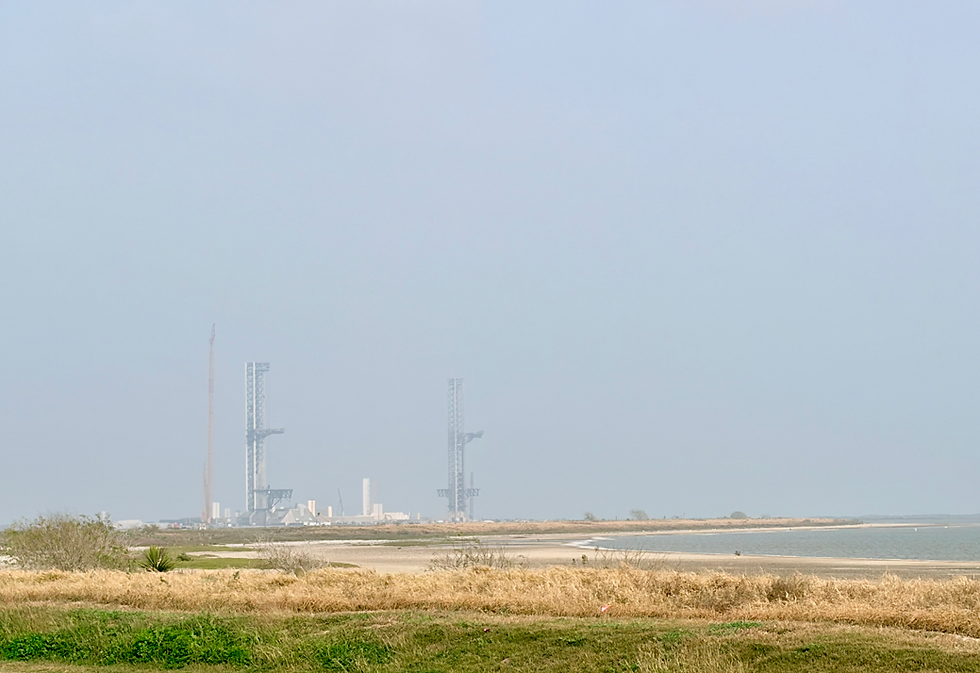
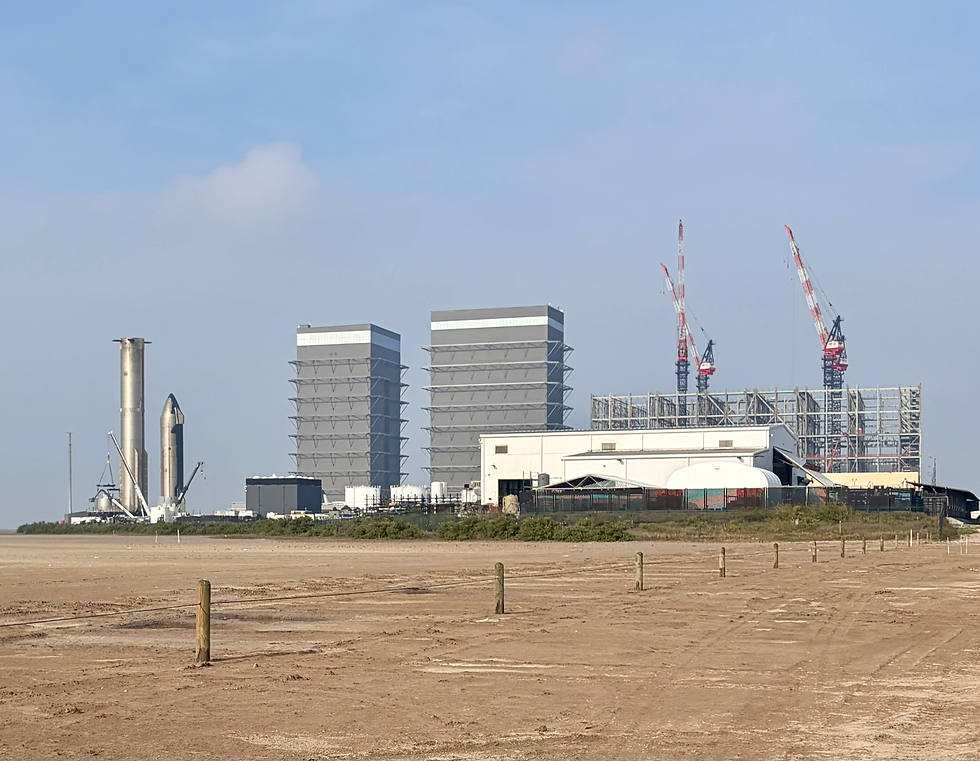
Boca Chica sits at the southern tip of Texas, at the end of State Highway 4. There, at the far end of a remote and threadbare country road, a vast construction site rises out of nowhere. This was once a small village on the Gulf of Mexico. Today it goes by a name known around the world: Starbase.
The approach itself tells the story. Trucks form long queues on the two-lane dirt road, cranes crowd the roadside, dust blocks the view, and the low, heavy clang of metal on metal serves as a kind of chorus for this restless site. I have driven through nearly forty American states and visited no shortage of industrial parks and production bases. This is the largest of them all. Everything here is being dismantled, leveled, hauled away, and rebuilt.
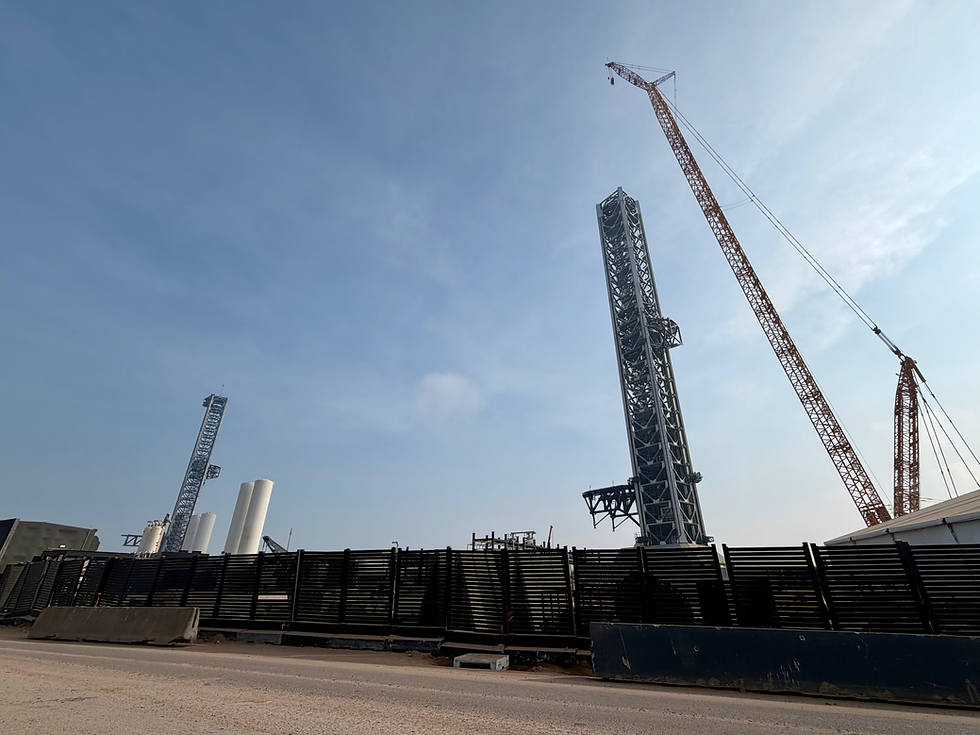
We stopped the car for the first time to take a photograph up close with the launch tower. A colossal mechanical arm hung suspended in midair, and beside it stood a crawler crane taller still.
Two enormous murals rise from the saline flats nearby. One is a portrait of Elon Musk, captioned "Ad Astra," Latin for "to the stars." The other is the internet's beloved Shiba Inu meme, Doge. Doge is not only Musk's favorite cryptocurrency mascot. It also happens to be the acronym and the totem of the Department of Government Efficiency (DOGE) that he briefly led.
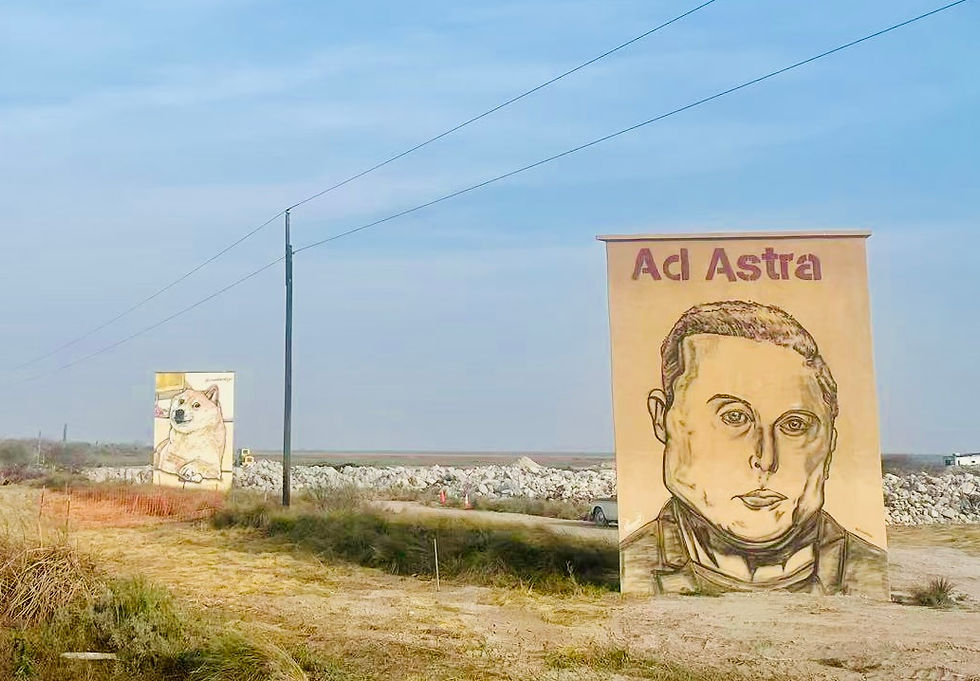
Standing side by side on this stretch of wasteland, the two murals probably describe the value system of this former village more accurately than any official slogan could.
Everything along the way looks raw and unpolished. There is no gentility, no ceremony, and the whole place feels perpetually on the verge of detonation. It reads like a projection of Musk's inner will onto this saline earth, pushing the Starship dream forward through visible, large-scale brute force.
2.
This is a scene utterly unlike Silicon Valley, and that contrast is precisely why I came. As a researcher of entrepreneurship, I can now explain the purpose of the trip.
Ever since the internet became commercial, innovation, the most important of human activities, has seemed confined to the virtual world of networks.
Peter Thiel put it in a line that has traveled widely: "We wanted flying cars, instead we got 140 characters." It appears in the 2011 manifesto of Founders Fund, the firm he leads.
He characterized this disparity as a split between advancement in the domain of bits—encompassing software, data, and digital networks—and inertia in the domain of atoms, which includes energy, transport, manufacturing, healthcare, and space exploration.
The economist Tyler Cowen issued a similar warning with his concept of the Great Stagnation, which calls attention to these two faces of innovation and to the serious consequences of the imbalance between them.
That imbalance has now lasted nearly thirty years. Fortunately, AI has arrived ahead of schedule.
AI is not only a matter of software and networks, nor only a matter of the consumer end. It will shape every corner of the physical world, from production all the way to consumption.
Strictly speaking, the Starship story at Boca Chica is not entirely an AI story. On the question of remaking the physical world, however, the two are strikingly aligned. When it comes to the impulse to build in the real world, Boca Chica is an outpost of the next revolution.
So will Boca Chica become the new Silicon Valley?
If Silicon Valley represents a refined and lightweight, software-driven entrepreneurship, what does Boca Chica represent? A heavy-metal, hardcore entrepreneurship? What are the traits of this entrepreneurial spirit, and what might they let us glimpse of the next and much larger wave of innovation?
Part of the answer lies in the sheer force of standing there in person. The rest is buried in the past twelve years of history, messy as they were and valuable for that reason. At least four things are worth salvaging from this stretch of saline flatland.
3.
A. Extraordinary endurance across long cycles and heavy capital
The union between SpaceX and Boca Chica was founded on September 22, 2014. Expectations at the time were quite conservative. This was to be no more than a backup launch site, meant to relieve scheduling congestion at other facilities, with an annual target of only twelve launches.
The turning point came at the end of 2018. Musk decided to abandon the carbon-fiber rocket body that the company had spent years and considerable money developing, and to switch entirely to stainless steel, which better withstands extreme temperatures. SpaceX gave up its leased facility in Los Angeles and moved the entire center of gravity of the Starship program to Boca Chica.
The scale that followed is easier to grasp in numbers. By 2026 the core site covers roughly 1,100 acres. Local employment has passed 4,000 and may exceed 8,000 before long. According to filings SpaceX has submitted to the SEC, the Starship program alone has consumed nearly ten billion dollars since 2023.
Time was the other cost. Nearly ten years separated the 2014 groundbreaking from the first fully stacked test flight in April 2023. Thirteen more integrated test flights followed, several of them ending in public explosions, until the first genuinely successful splashdown arrived in July 2026.
This reality extends far beyond SpaceX; it defines the fundamental nature of pioneering physical engineering. The marginal cost of trial and error in software is low, sometimes close to zero, which is the core reason software innovation can be so light on its feet.
Trial and error in hardware is another matter. Rocket bodies, launch towers, and foundations involve materials, labor, land, logistics, and even regulatory approval, and the cost of error runs extremely high. Hardcore building innovation is therefore destined to be a long war of capital and endurance.
There is a further implication. Convincing capital to sustain immense, long-term losses alongside you, and to continuously reinvest despite recurrent setbacks represents a rare and essential entrepreneurial ability in its own right. For innovation that builds things in the physical world, this is the core threshold.
B. The ambition to rebuild infrastructure end-to-end
SpaceX’s very first challenge at Boca Chica arose directly from the land underfoot.
Soft coastal silt and saline sand could not bear the loads that launch requires, not even static loads. The company had to truck in more than 300,000 cubic meters of fill and then wait for the foundation to settle and compact, a wait of nearly two years. For a time it was mocked as another of Musk's abandoned projects.
Out of that early period came one of the more absurd scenes in the howling dust of South Texas, a kind of frontier rocket-building. Starship workers pitched large tents, recruited welders from local farms, and assembled the Starhopper by hand. The scene pulled spacecraft manufacturing out of the ivory-tower cleanroom and back into something closer to an old shipyard.
Crude as it looked, it worked. In August 2019 that Starhopper rose, hovered for 57 seconds, and landed squarely, and the aerospace world took notice.
The same instinct runs through the whole program. Upstream, SpaceX makes its own raw materials. Midstream, it keeps design, final assembly, and testing in house rather than outsourcing them. Downstream, it declines to rent external launch infrastructure, building its own launch tower and "chopstick" arms instead. Together these choices display an ambition to rebuild an entire infrastructure chain end to end, without placing it in anyone else's hands.
To avoid the cumbersome and repetitive coordination required with external regulatory and municipal entities, Starship went so far as to establish its own municipality, Starbase, and elect a SpaceX executive to serve as its mayor.
The contrast with software is instructive. A software founder can rent mature infrastructure such as cloud servers and concentrate on creating value in one short segment of the chain. Genuine innovation in physical building rarely finds such infrastructure waiting. Suppliers cannot meet the required precision, local governments approve too slowly, and so on down the list.
Left with no alternative, the frontier hardcore builder rebuilds the entire chain from beginning to end. This is a vertical building impulse that refuses to depend on any aging external system.
Framed in this light, pioneering deep-tech building generates a substantial positive spillover. It radiates backward and forward across the supply chain, lifting the broader industry alongside it.
C. Educating the old system through failure in broad daylight
Between December 2020 and March 2021, SpaceX rolled four Starship prototypes onto the pad in succession, SN8, SN9, SN10, and SN11, to test the difficult landing maneuver known as the belly flop.
All four failed, each in its own way. Some broke apart in the air, others caught fire on landing. Every failure was livestreamed from beginning to end, and the next day the company would announce the test plan for the following prototype as though nothing had happened.
Not until May 2021 did SN15 execute the whole sequence cleanly and come to rest upright. Livestreaming failure this way is rare in the traditional aerospace industry, and for software innovation it is unimaginable.
Yet it follows logically from the nature of frontier hardcore building. The critical parameters of the physical world are hard to obtain through simulation in a sealed laboratory. Only on a real and public test stand can a company gather accurate and complete feedback, including feedback from the public.
The two paradigms also understand failure differently. When a software product fails at launch, the loss is usually confined to a code rollback and a bruised user experience. When frontier hardcore building fails, the bill can be enormous, and the failure is visible, sometimes spectacularly so. That visibility carries a value of its own.
What frontier building most needs to break through, after all, is the old framework of assumptions and rules. Laying failure out in broad daylight may be the best way to educate an old system.
Doing so exposes the full process by which a problem is found and fixed. Internally it builds the widest possible consensus. Externally it seeks understanding, resonance, and trust.
Reducing resistance systematically, inside and out, including through public failure, is another core capability of the frontier-building entrepreneur.
D. Entrepreneurial corporate governance and the management of risk
Economics has long carried a current of skepticism toward traditional corporate governance. On this view, the so-called well-developed governance apparatus turns a commercial company into a quasi-bureaucracy and severely suppresses entrepreneurial spirit.
SpaceX practices something different, a form of entrepreneurial corporate governance. Musk makes most of the important decisions himself, engineering decisions included.
One episode captures the style. Around 2021 Musk lived near the launch site in a prefabricated cabin, a Casita worth only fifty thousand dollars. He would inspect the assembly line in the small hours, and whenever hoisting work fell behind he would issue an all-hands mobilization order, a Surge.
He required managers to sleep beside the production line, on the grounds that "urgency is the first driver of innovation."
Highly centralized decision-making of this kind may be an inevitable product of frontier hardcore building rather than a mere matter of managerial taste.
The impulse to build at the frontier generally begins in non-consensus, and it depends on one entrepreneur's vision, conviction, and decisiveness. Centralized decisions raise efficiency, and in practice they raise the probability of success as well, particularly in the early and middle stages of a project.
Traditional procedures such as risk assessment, repeated rounds of deliberation, and shareholder inquiry can cost a company its window of opportunity while doing little for the quality of its decisions.
This double-edged trade-off inherently carries both advantages and vulnerabilities. Entrusting a company's trajectory so completely to the single-minded focus, vigor, and physical wellbeing of one leader introduces unavoidable exposure to volatility and risk. Because there is no universal template for managing this tension, recalibrating this balance depends on the specific individual, the nature of the undertaking, and its current phase of maturity.
4.
Boca Chica takes its name from the Spanish phrase for "little mouth," describing the narrow estuary where the Rio Grande flows into the Gulf of Mexico. Prior to SpaceX's arrival, this secluded locale was stark, desolate, and sparsely inhabited.
Today Boca Chica is a spaceport city that combines research and development, manufacturing, testing, and orbital launch, and a spiritual landmark for the exploration of Mars and for frontier building.
There is a precedent for this kind of transformation. Back in 1955 William Shockley, the inventor of the transistor, set up his laboratory in the modest Stanford Industrial Park, at 381 San Antonio Road in Mountain View. That address later became the birthplace of what we now call Silicon Valley.
The true importance of Boca Chica isn't about whether it will emerge as the next Silicon Valley. Rather, it serves as an early—if unpolished—demonstration of how innovation functions as it returns to the physical realm: driven by grand vision, relentless effort, trial and error, substantial capital, time investment, independent thinking, and accountability. As artificial intelligence prepares to reshape the physical world, Boca Chica provides a compelling preview of what lies ahead.
References:
《Elon Musk》, Walter Isaacson
《Elon Musk: Tesla, SpaceX, and the Quest for a Fantastic Future》, Ashlee Vance
《The Great Stagnation》, Tyler Cowen
《Zero to One: Notes on Startups, or How to Build the Future》, Peter Thiel

Comments